
ACCESS THE FULL WHITE PAPER HERE
A refrigerated specialty medication leaves the pharmacy packed for 2°C to 8°C, rides through a long summer afternoon in a delivery van, and spends part of the trip at 14°C. That falls under the 15°C maximum USP allows for a refrigerated excursion, yet the data logger still flags it. Someone on the operations team now has to decide whether that product is still fit for the patient waiting on it, and the decision usually runs through a single number: Mean Kinetic Temperature, or MKT.
How that number gets calculated decides whether the patient receives the dose on time, waits on a replacement, or receives a product that lost potency along the route. USP ⟨1079.2⟩, the chapter that governs MKT in temperature excursion evaluations, was revised in August 2025, and several calculation habits still common in specialty pharmacy fall outside what it allows.
What MKT measures
MKT is a single calculated temperature that represents the cumulative thermal stress a product has experienced over a defined period. It uses the Arrhenius equation to give higher temperatures more weight than a simple average would, because chemical degradation speeds up at a non-linear rate as temperature climbs.
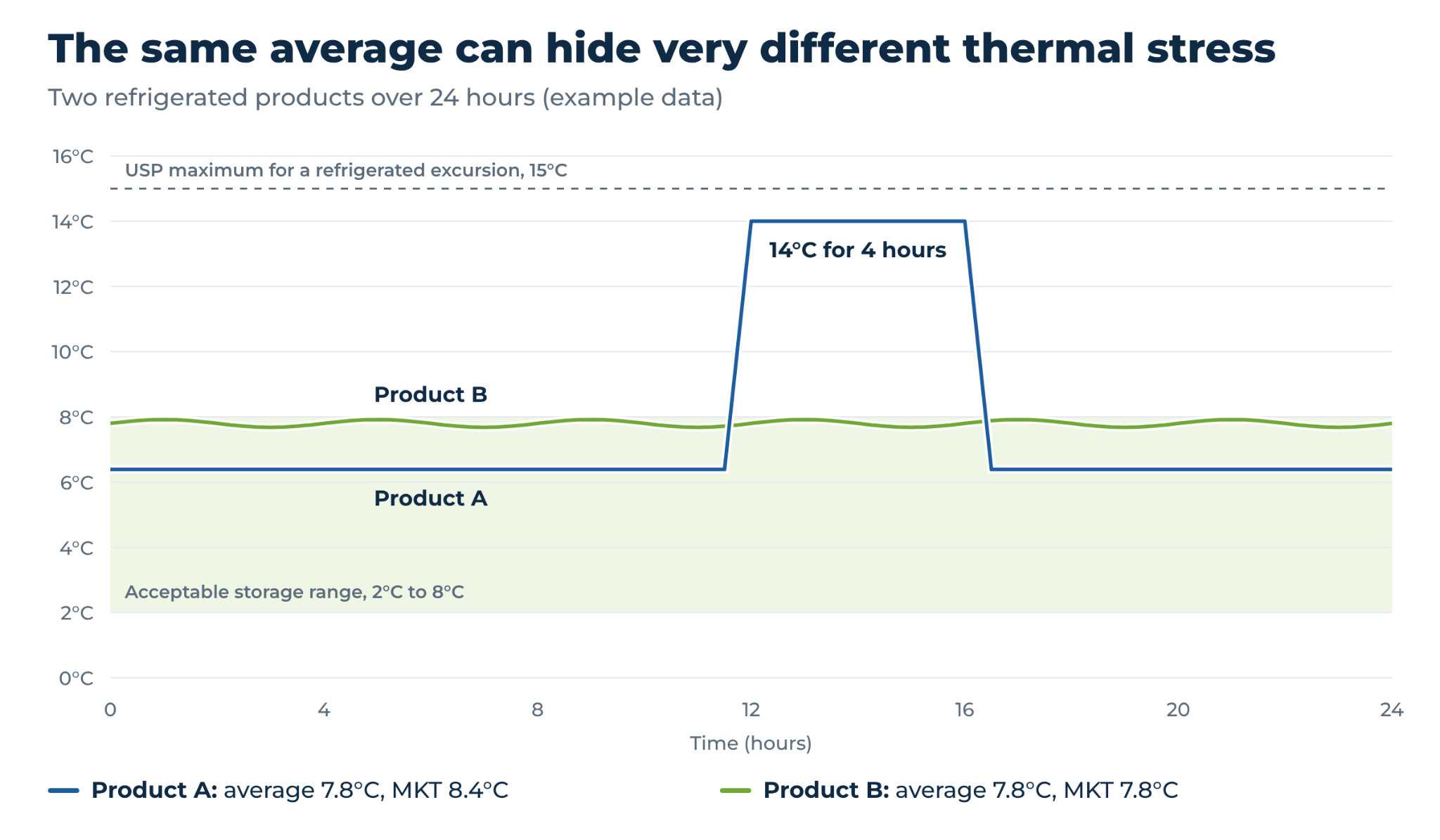
Picture two products that share the same average temperature across 24 hours. One held steady the whole time, and the other spent a concentrated stretch at 14°C. A simple mean reports them as identical. MKT shows the second product absorbed considerably more thermal stress, which is the difference that matters for its stability.
What MKT is not
USP is direct about the tool’s limits. The chapter states that “MKT alone is not enough to assess the impact of a temperature excursion.” An excursion remains a nonconforming event, and MKT is one way to evaluate its impact on the product. That leaves four jobs MKT should never be asked to do:
Where the August 2025 revisions draw the lines
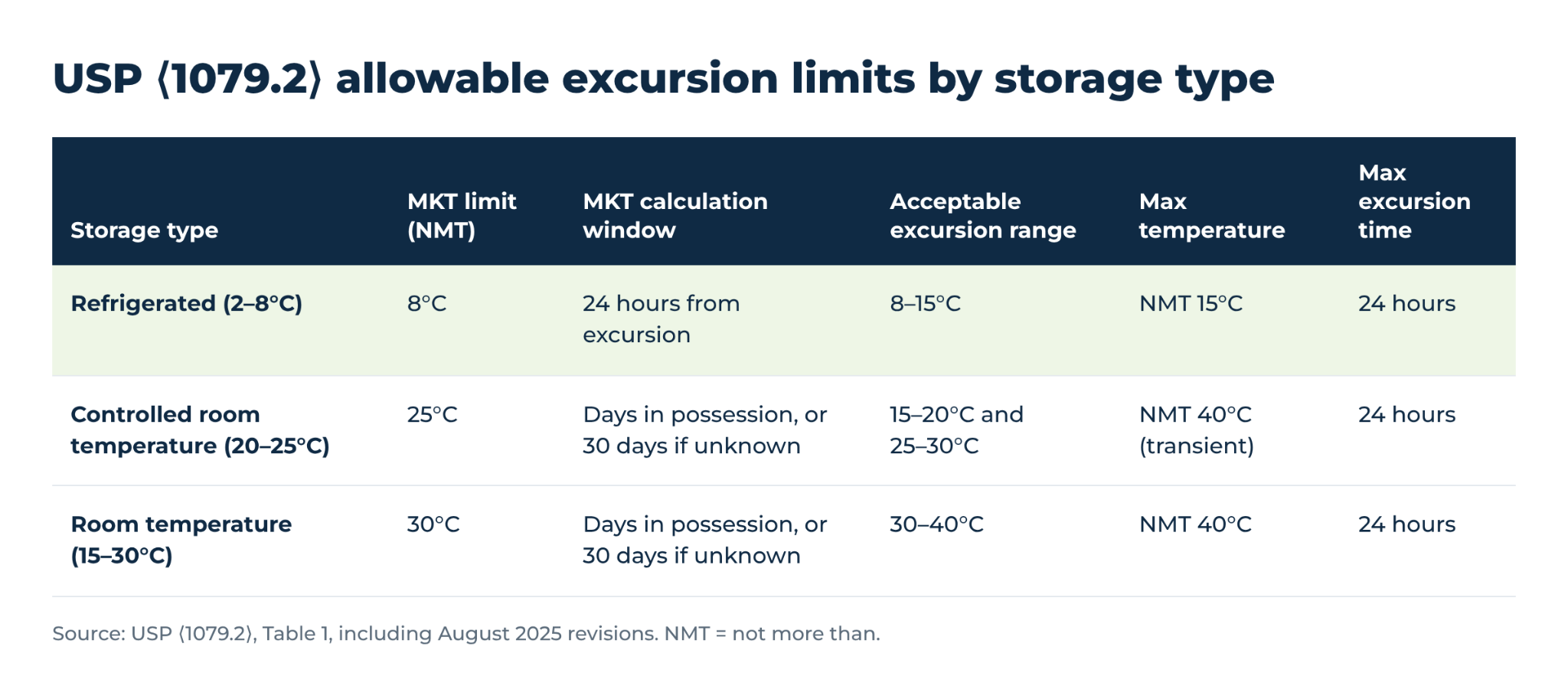
For controlled room temperature products, the 30-day window is a default for situations where the pharmacy does not know how long it has held the product. It reflects data showing products spend an average of about 30 days in U.S. warehouse storage. A pharmacy that tracks actual dwell time should use that number instead.
Refrigerated products are held to a much tighter standard. MKT for a refrigerated excursion uses only the preceding 24 hours of temperature data, and each excursion is treated as a separate, independent event. The chapter describes a storage or transportation system with repeated refrigerated excursions as a system out of control.
Three calculations that shrink an excursion on paper
Go back to the van. The most widely cited misuse in the chapter would take that afternoon at 14°C and calculate MKT across a full 52 weeks of temperature data from the storage location. A year of steady readings dilutes a few hot hours until the product appears unaffected, and USP calls this practice out by name. The product may not have spent anywhere near 52 weeks in that location, which makes most of that data irrelevant to its condition.
The second shortcut happens after delivery. Once the shipment returns to controlled storage, those cooler hours can pull the calculated MKT back under the limit and create the appearance of compliance. USP cautions against this directly. Degradation, potency loss, and reduced stability that occurred at elevated temperature cannot be reversed by later exposure to lower temperature. The assessment period should stay focused on the storage or transportation interval in which the excursion happened.
The third gap is treating MKT as the whole evaluation. USP ⟨1079.2⟩ expects every MKT result to sit alongside documented answers to four questions:
A complete excursion record documents all four, along with scientifically sound justification for the disposition decision.
Products MKT cannot speak for
Some of the therapies specialty pharmacies dispense most often sit outside MKT entirely. USP identifies MKT as potentially unsuitable for biologics, for products subject to phase change such as suppositories, liquids, suspensions, emulsions and creams, and for any product where clinical data show excursions affect quality or safety regardless of the MKT result. For these products, USP points to stability and stress studies, freeze-thaw studies, and high-temperature cycling studies to assess risk, and it expects the drug manufacturer to communicate when MKT is the wrong tool.
A pharmacy that dispenses biologics should confirm its excursion SOP routes those products to an alternative assessment method.
Fewer excursions, fewer investigations
USP ⟨1079.2⟩ gives pharmacies a clear framework for evaluating excursions. The harder work is closing the distance between that framework and the way excursion investigations run day to day.
MKT also earns its place earlier in the process. During packaging qualification and shipping lane validation, an understanding of cumulative thermal exposure helps a pharmacy choose packaging that keeps product inside its range on its real routes. Every excursion that never happens spares the pharmacy an investigation and spares a patient the wait for a replacement dose.
The full white paper includes a nine-point checklist for comparing your current excursion SOP against USP ⟨1079.2⟩. Download the white paper here
If the checklist surfaces gaps, our team can walk through your current packaging and shipping lanes with you in a complimentary 30-minute review and show where fewer excursions would mean fewer investigations. Schedule a 30-minute review
References


Efficient Solutions, Exceptional Results.