A platelet unit leaves the blood center on a short clock. Platelets are stored at 20 to 24 °C under continuous gentle agitation, and most expire on day five unless the center adds secondary bacterial testing to reach day seven. Every hour a box spends on a delayed truck or a missed connection comes out of that window, and a shipper that lets the unit drift out of range turns a scarce donation into a discard before it ever reaches the patient who needed it.
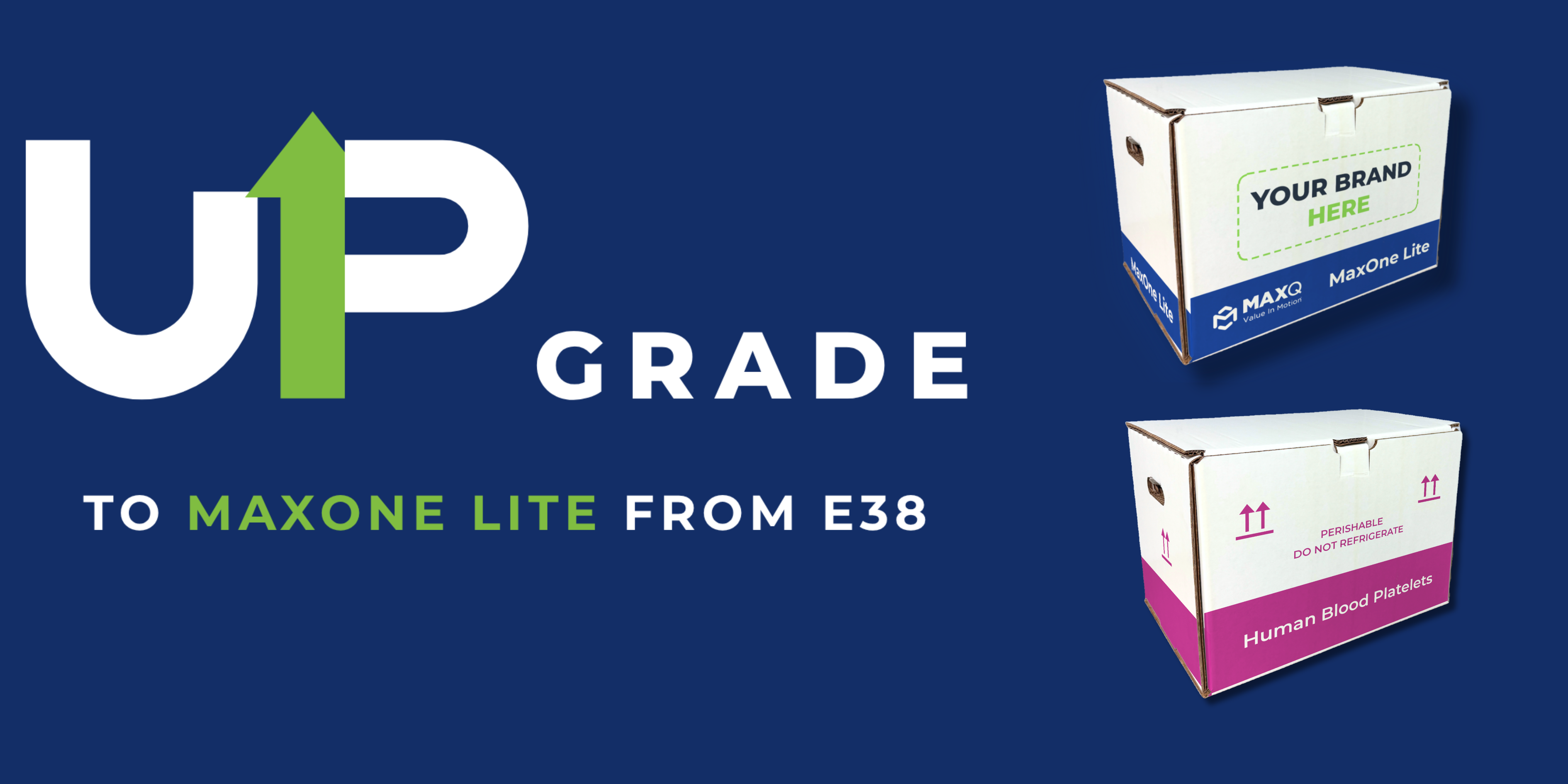
That pressure shaped MaxOne Lite. For hospital services teams that send platelets across the country by UPS, FedEx or airline, Lite is the shipper built for that trip, and it belongs to a MaxOne line with more than 3,000 units deployed at blood centers. Centers are replacing the E38 with it for reasons that start with capacity.
Twice the platelets, with every gel pack left in place. MaxOne Lite carries 12 platelet units to the E38's 6. Packers often reach a full E38 load only by pulling gel packs to make room, a common workaround that gives up the thermal protection the units depend on. Lite holds all 12 units with its full coolant packout in place, and it fits the larger Cerus INTERCEPT pathogen-reduced platelet bags without pressing on them in transit.
Built for the carrier lane.
MaxOne Lite pairs vacuum-insulated construction with an exterior shell made for carrier and airline handling. Vacuum insulation works on the same principle as a vacuum-insulated coffee mug, slowing heat transfer far more than foam of the same thickness. The box packs out with wet ice, dry ice, phase change coolant or gel packs, so one shipper covers whole blood, red cells, platelets and plasma, and the packing area stocks one box where it once stocked three or four.
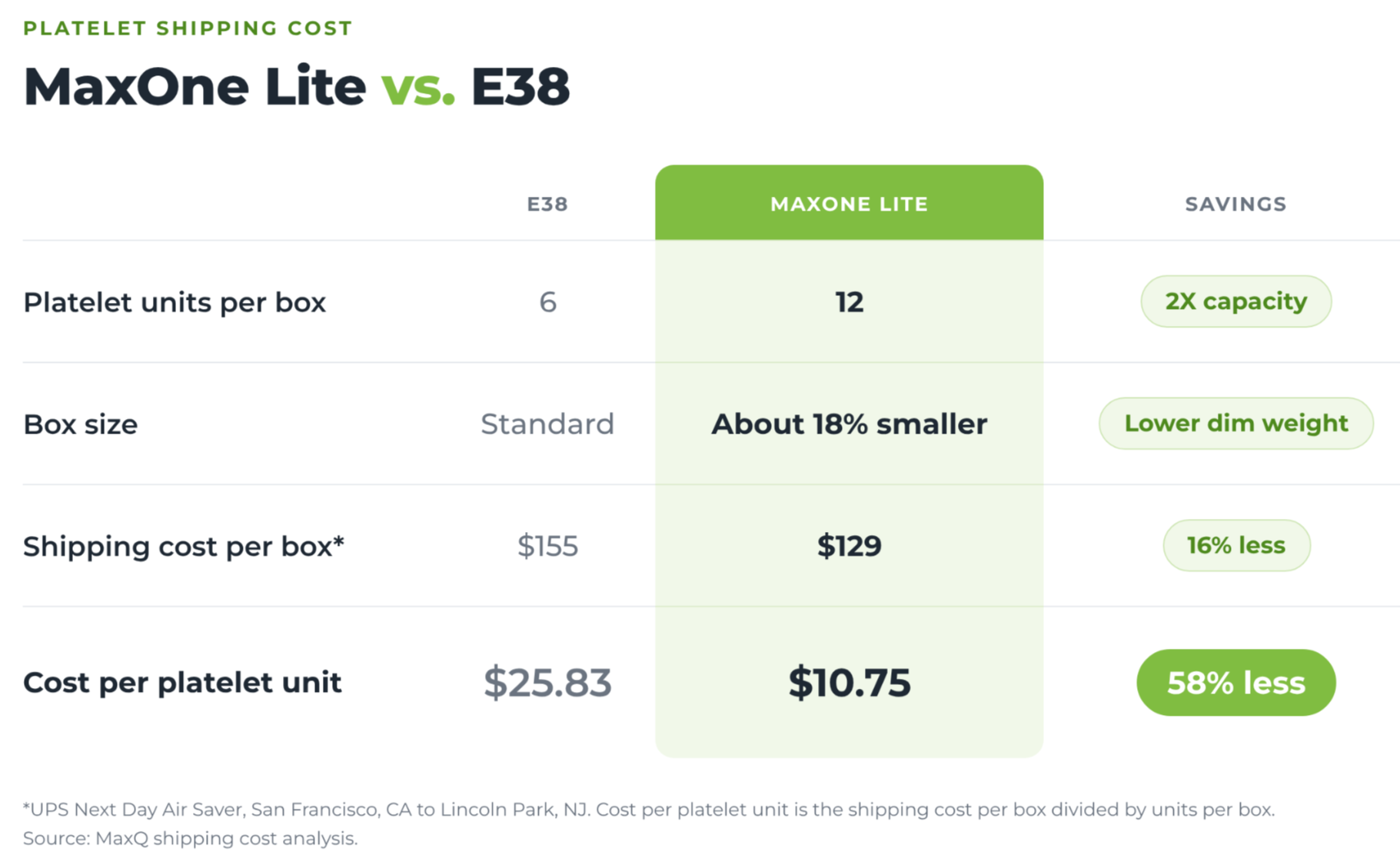
A smaller box and a smaller bill per unit
MaxOne Lite is about 18% smaller than the E38, and carriers bill by dimensional weight. Pair that with twice the platelet capacity, and the cost of shipping each unit drops by more than half. Across all lanes, MaxQ projects a 5 to 10% reduction in shipping costs for its clients.
Lowest cost per shipment when the boxes come home. MaxOne Lite is built to return, with materials rated for a five-year service life. Asked during a May 2026 BCA supplier webinar which MaxOne variant costs least, MaxQ co-founder and CEO Saravan said that when containers come back frequently, "over time, MaxOne Lite is the most cost-effective solution".

Your name on the box.
MaxOne Lite is re-skinnable, so a hospital services program can ship in a box printed with its own brand, with custom skins available from 250 units.
Validated against the conditions shipments actually meet. Validation claims across the industry run anywhere from about 18 to 45 hours, with no shared standard for how those hours were tested. MaxQ qualifies MaxOne Lite against ISTA 7E ambient profiles, which ISTA built from years of recorded temperatures along real US shipping lanes, and in that testing Lite delivered at least twice the thermal protection of the E38. MaxQ shares its base validation reports and works alongside each center through its own internal validation.
-------------------------------------------------------------------------------------------
See MaxOne Lite on your own lanes. Book 30 minutes with Balaji and MaxQ
will send a demo unit and the base validation report for your team to test:
------------------------------------------------------------------------------------------
References


Efficient Solutions, Exceptional Results.