
Every medication delivery carries a patient’s trust and a pharmacist’s promise. Protecting that medication while managing the cost of delivery takes more than choosing a box. It takes the right combination of packaging, thermal protection, and carrier service.
With UPS and FedEx announcing another round of rate increases, now is a good time to review that combination.
UPS’s 2027 Daily Rates for Ground, Air, and International services increase an average net 5.9%, effective December 21, 2026. FedEx’s standard list rates for U.S. domestic, export, and import package services increase an average 5.9%, effective January 4, 2027.[1,2] Actual costs depend on your agreement, shipping profile, and applicable fees.
For pharmacies shipping 20 packages a week or 10,000, small differences in cost per prescription can add up quickly.
Start with the service level, then find the right packaging balance
In our experience working with pharmacy customers, the premium for a faster delivery commitment often has a greater effect on shipping cost than a few pounds of dimensional weight. Moving from a later next-day commitment to priority morning delivery can cost more than shipping a somewhat larger, better-protected package.
That creates an opportunity. Packaging with sufficient qualified thermal duration may support a later delivery commitment while maintaining an appropriate protection margin.
But there is a sweet spot. As a shipper becomes larger or heavier, its freight and packaging costs can offset the service savings. Your negotiated rates, destination zones, actual packed weight, and patient receiving requirements determine where that balance sits.
The goal is to find the lowest total delivered cost that supports the medication’s requirements and your pharmacy’s demonstrated shipping conditions.
1. What are you paying for your delivery commitment?
Review your most common lanes and the actual difference between priority morning and later next-day services under your contract. Compare net charges, including applicable surcharges and minimums.
A later commitment may still arrive the next day. Check the destination-specific commitment and the patient’s receiving needs.
2. What is the billable weight of your shipper?
Measure the outside of the fully packed, closed box. Calculate DIM weight using your carrier agreement’s divisor and dimension-rounding rules.
Carriers generally compare actual weight with dimensional weight when determining the chargeable weight.[3] A compact box can help control cost, but the effect on your invoice also depends on minimum charges and negotiated rates.
3. How long did your pharmacy actually demonstrate temperature protection?
Review your performance qualification (PQ) results alongside the supplier’s qualification evidence. Consider the payload, coolant preparation, packing procedure, seasonal conditions, and time from pack completion to patient receipt.
Use the duration supported by your evidence. A shipment observed for 24 hours does not demonstrate 48 hours of protection.
4. Would a different shipper improve the complete delivery program?
A new shipper could be smaller, larger, lighter, or capable of protecting medication for longer. Evaluate how those changes affect both your carrier options and total cost.
If you currently use a mailer or an off-the-shelf insulated box, include materials, packing labor, storage, and inbound freight in the review. The purchase price of the packaging is one part of the decision.
We built a simple tool to help you start this review.
Compare your pharmacy’s cold chain shipper
Enter your current box dimensions, carrier DIM divisor, rounding rule, and qualification duration. Add the dimensions of the complete prescription payload, including its cartons and protective materials.
The calculator identifies the smallest dimensional fit among the listed PharmaPack configurations and shows:
It is a practical first comparison. Confirm payload orientation, pack-out, temperature range, and applicable qualification evidence before selecting a shipping configuration.
The tool also creates a prompt that updates with your inputs and comparison. Copy it into ChatGPT, Claude, or your preferred AI tool to explore the shipping-cost implications using your own rates. Follow your organization’s AI policy when sharing agreements or invoices.
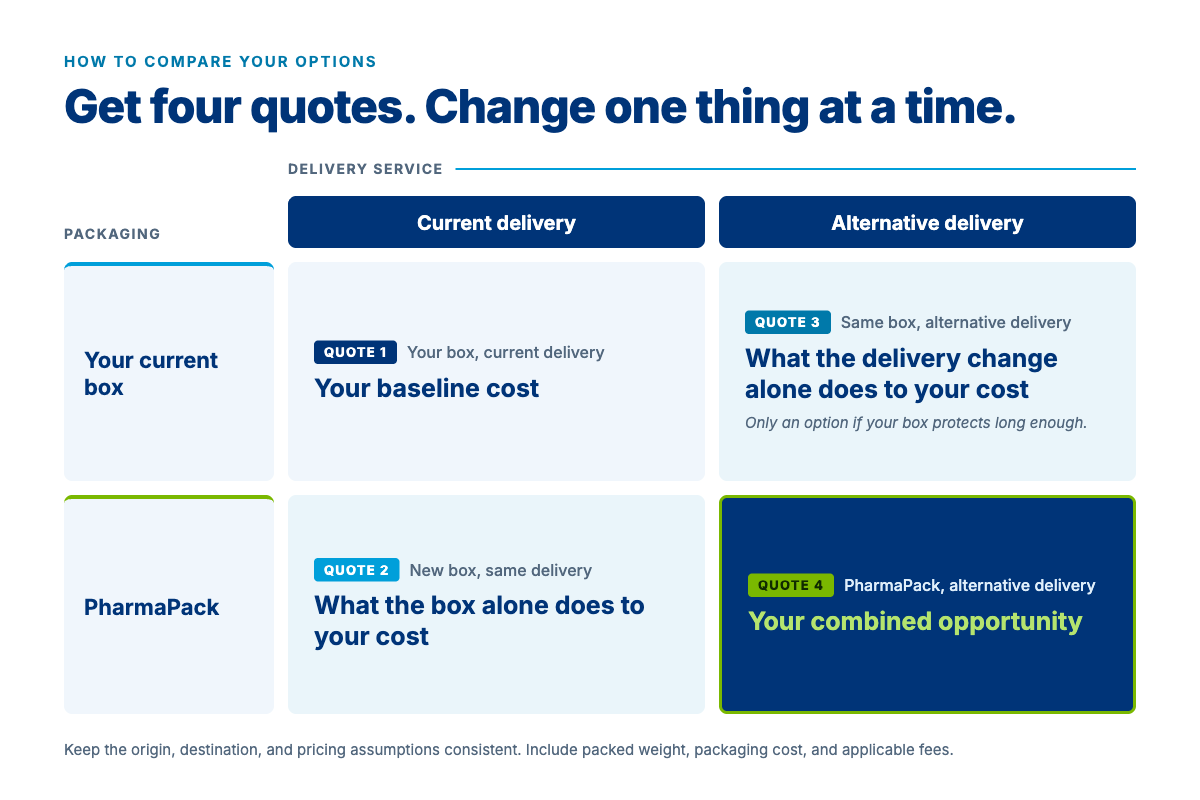
If you have no rate documents handy, ask your carrier for four net quotes on a representative lane: each shipper priced on your current service and on the alternative service. That gives you a starting point for finding the sweet spot.
If the proposed packaging adds $2 per shipment but enables a service change that saves $6, the combined saving is $4 per shipment before other cost differences. At 250 shipments a week, that would equal $1,000 a week or $52,000 over 52 shipping weeks. This is an illustrative calculation. Your contract and operating costs determine your result.
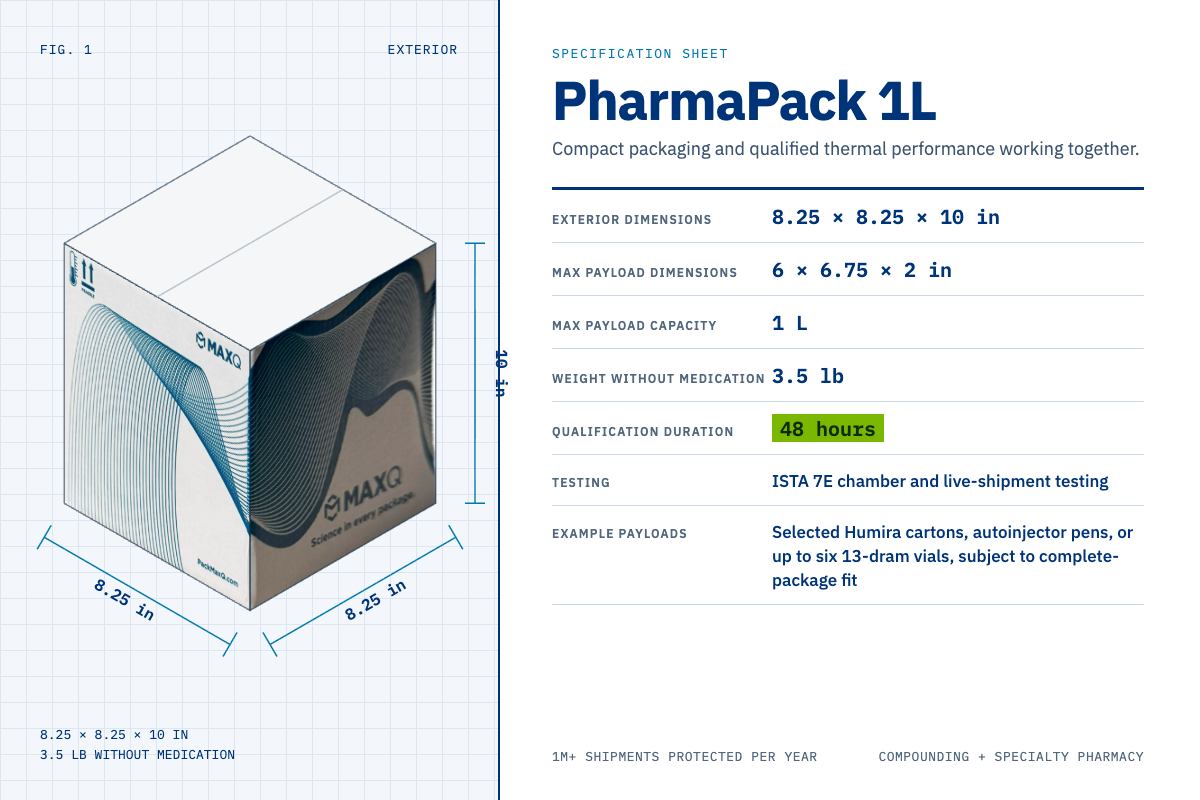
PharmaPack 1L: Let's unpack an example of the balance
PharmaPack is a purpose-built, proven packaging solution for compounding and specialty pharmacies, protecting more than 1 million shipments per year.
The 1L shipper illustrates how compact packaging and qualified thermal performance can work together.
Its DIM weight depends on the carrier divisor and rounding rule. At a divisor of 139, rounding each exterior dimension upward to whole inches produces a 9 × 9 × 10-inch calculation and a 6 lb DIM weight. Final billable weight also depends on the fully packed actual weight and applicable contract terms.
For a suitable payload and lane, the 48-hour qualified duration may support later next-day delivery with additional thermal margin. Evaluate that margin from pack completion through actual receipt, including pre-pickup time and potential delays.
Other payloads may call for a different PharmaPack size. The calculator compares listed 1L, 3L, 6L, and 26L configurations so you can see the dimensional and duration trade-offs.
Packaging supply should fit your pharmacy, too
PharmaPack is available in quantities from cases to full truckloads, with deliveries aligned to your needs. Its space-efficient supply format helps pharmacies manage storage and replenishment alongside daily fulfillment.
Whether you are expanding a small shipping program or supporting thousands of weekly prescriptions, the packaging should work for the people receiving, storing, and packing it.
Start with your current shipper and see how it compares.
The comparison page lets you request a price quote, a demo shipper, or both.
Compare your shipper and request a quote or demo
We can help you evaluate the packaging, service level, and thermal protection together, so you can control delivery costs while protecting medication, patient confidence, and the pharmacy operations behind every shipment.
References
Lorem ipsum dolor sit amet, consectetur adipiscing elit, sed do eiusmod tempor incididunt ut labore et dolore magna aliqua. Ut enim ad minim veniam, quis nostrud exercitation ullamco laboris nisi ut aliquip ex ea commodo consequat. Duis aute irure dolor in reprehenderit in voluptate velit esse cillum dolore eu fugiat nulla pariatur.
Block quote
Ordered list
Unordered list
Bold text
Emphasis
Superscript
Subscript


Efficient Solutions, Exceptional Results.